Most garage door openers last 10 to 15 years. Most doors last 15 to 30. Springs wear out by use, not age, so a busy household can need new ones in 7 years while the panels look fine for decades. Below is what to expect from each part of the system, and how to tell when one is close to done.
Every part at a glance
These are typical ranges for a residential door in metro Atlanta. Heavy use, humidity and skipped maintenance push a part toward the low end.
| Part | Typical life | First sign it's wearing out |
|---|---|---|
| Opener | 10 to 15 years | Strains, stalls or reverses for no reason |
| Springs (standard, 2 to 4 cycles a day) | About 7 to 14 years | Door feels heavy, gaps in the coil |
| Door panels (steel) | 15 to 30 years | Rust, cracked seams, dents that bind |
| Lift cables | 8 to 10 years | Frayed strands near the bottom brackets |
| Hinges | 15+ years | Cracks near the screw holes, sagging sections |
| Rollers (steel) | 5 to 7 years | Grinding, wobbling wheels |
| Rollers (nylon, sealed bearing) | 10 to 15+ years | Flat spots, a rougher sound |
| Bottom seal | 5 to 8 years | Daylight or water at the corners |
| Safety sensors | 15 to 20 years | Door reverses even when aligned |
| Backup battery | 2 to 3 years | Opener beeps, battery light turns orange or red |
01How long do garage door openers last? 10 to 15 years
Most openers last 10 to 15 years. The motor often outlives that range, but the logic board or the drive gear usually gives out first. If the motor hums and the door doesn't move, the drive gear is usually stripped.
Weak springs, heavy daily use and power surges all shorten an opener's life. Weak springs are the big one, because the opener ends up lifting weight it was never built for. Summer thunderstorms are hard on logic boards too, so a surge-protected outlet is cheap insurance.
Repairing an opener usually makes sense for its first 8 years or so. After that, replacing it tends to cost less over time than chasing parts. One exception has nothing to do with wear: if your opener was made before 1993, replace it. Federal law has required safety sensors on residential openers since then, and older units don't have them. If yours is acting up, our opener troubleshooting steps can rule out the simple causes first.
02How long do garage door springs last? It depends on cycles
A garage door weighs 130 to 350 pounds, and the springs carry nearly all of it. That's why they are usually the first major part to fail.
Springs are rated in cycles, and one cycle is one open and one close. A standard torsion spring is rated for about 10,000 cycles:
- At 2 cycles a day, a standard spring lasts about 14 years.
- At 4 cycles a day, which is typical for a busy family, it lasts about 7 years.
- At 8 cycles a day, it may only last 3 to 4 years.
To estimate your own number, count trips. Each time a car leaves and comes back is usually two cycles. Extension springs, the kind that stretch along the tracks, carry similar ratings.
High-cycle springs rated for 25,000 cycles last about two and a half times longer. They make sense if you use the garage as your front door. The full cycle table is in our spring size chart.
03How long does the door itself last? 15 to 30 years
The panels outlast everything else on the door, and how long they go depends mostly on how they're built. Amarr puts a single-layer steel door, one sheet with no insulation, at about 15 to 20 years. A triple-layer door, with insulation sandwiched between two steel skins, can last 25 to 30. Wood doors last only as long as their finish. Seal or paint them every few years, or rot starts at the bottom section.
Georgia humidity is hard on bare steel and unsealed wood. Rust usually starts where the bottom seal meets the panel, so check that edge first. A single dented panel can often be swapped out if your door is still in production, which is what panel replacement covers.
04Cables and rollers
Lift cables run from the bottom corners of the door up to drums above it and usually last 8 to 10 years. Look for frayed strands near the bottom brackets, but don't touch them, since they're under spring tension. Cables have worked the same cycles as the springs, so many techs replace them during a spring job.
Rollers depend on what they're made of. The steel rollers on many builder-grade doors are loud and last about 5 to 7 years. Nylon rollers with sealed bearings run quieter and last 10 to 15 years or more. A worn roller usually announces itself with a grinding sound as the door moves.
05Seals and safety sensors
The bottom seal takes a beating at the floor line and often needs replacing within 5 to 8 years. Once it cracks or shrinks, you'll see light at the corners and get water and bugs inside. It's one of the few parts you can replace yourself.
Safety sensors last 15 to 20 years. As they age they can fail intermittently, and the door may reverse even when they're lined up. Spring pollen and red-clay dust coat the lenses fast here, so wipe them with a soft cloth before you assume they're bad. If that doesn't help, check the sensor alignment next.
06Remotes, keypads and batteries
Batteries need changing more often than anything else on the door. A remote's CR2032 coin cell lasts 3 to 5 years, a wireless keypad battery 1 to 2 years, and an opener's backup battery 2 to 3 years. A remote that only works close to the door usually just needs a new cell. Check which battery your opener uses before you buy one.
How to make your garage door last longer
- Lubricate twice a year. Hinges, rollers and springs all benefit. Use a garage-door lubricant, not a degreaser, and skip the tracks, where grease collects dirt and makes rollers skid. The lubricant guide shows what to use and where.
- Run a balance test. With the door closed, pull the red release cord. Lift the door by hand to about waist height and let go. If it drifts down or shoots up, the springs are worn or out of adjustment. Call a tech rather than adjusting them, and reconnect the opener before you use it again.
- Run a reverse test. Lay a roll of paper towels flat under the door and close it with the opener. The door should touch it and reverse. If it doesn't, stop using the opener until it's fixed.
- Keep the sensors clean. Dirty lenses make the door reverse, which adds wear to the opener.
- Fix small problems early. A worn roller or loose hinge puts extra load on everything else.
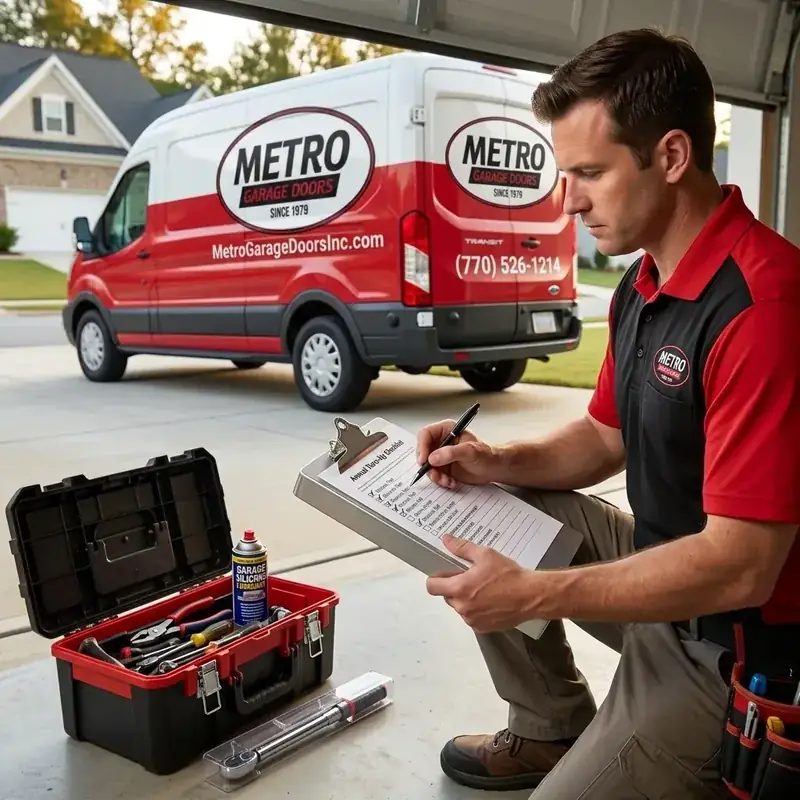
- Get a yearly tune-up. A tech checks spring balance, cable wear and opener force settings. Here's what our annual tune-up includes.
Repair or replace?
Springs, cables, rollers and seals are all designed to be replaced, so most problems are repairs. A new door makes more sense when several of these are true:
- The door is over 20 years old and showing rust or cracked panels.
- Replacement panels for your model are no longer made.
- It's a single-layer door, and you want a warmer or quieter garage.
- You're paying for repairs more than once a year.
If someone quotes you a new door over one broken spring, get a second opinion. Here's how to spot an upsell.
These are averages. Your door can beat them or fall short depending on use and upkeep. If you want a second set of eyes in Smyrna, Roswell or elsewhere in metro Atlanta, call us at (770) 526-1214 or send us a message.
FAQ
How long do garage door openers last?
Most garage door openers last 10 to 15 years. The logic board or drive gear usually fails before the motor. Repairs usually make sense for the first 8 years or so. After that, replacing the opener often costs less over time.
How long do garage door springs last?
A standard torsion spring is rated for about 10,000 cycles. That is about 14 years at two cycles a day, or about 7 years at four. High-cycle springs rated for 25,000 cycles last about two and a half times longer.
How long does a garage door last?
Most garage doors last 15 to 30 years. Amarr puts a single-layer steel door at about 15 to 20 years, and a triple-layer steel door at 25 to 30 years. Wood doors need sealing or painting every few years to reach that range.
How do I know when to replace my garage door?
Consider a new door when it is over 20 years old with rust or cracked panels. Replacement also makes sense when panels are no longer made, or repairs come more than once a year. Most single problems, like springs or cables, are repairs.
How can I make my garage door last longer?
Lubricate the hinges, rollers and springs twice a year, and keep the safety sensors clean. Run a balance test and a reverse test now and then, and fix small problems early. A yearly tune-up catches worn springs and cables before they fail.