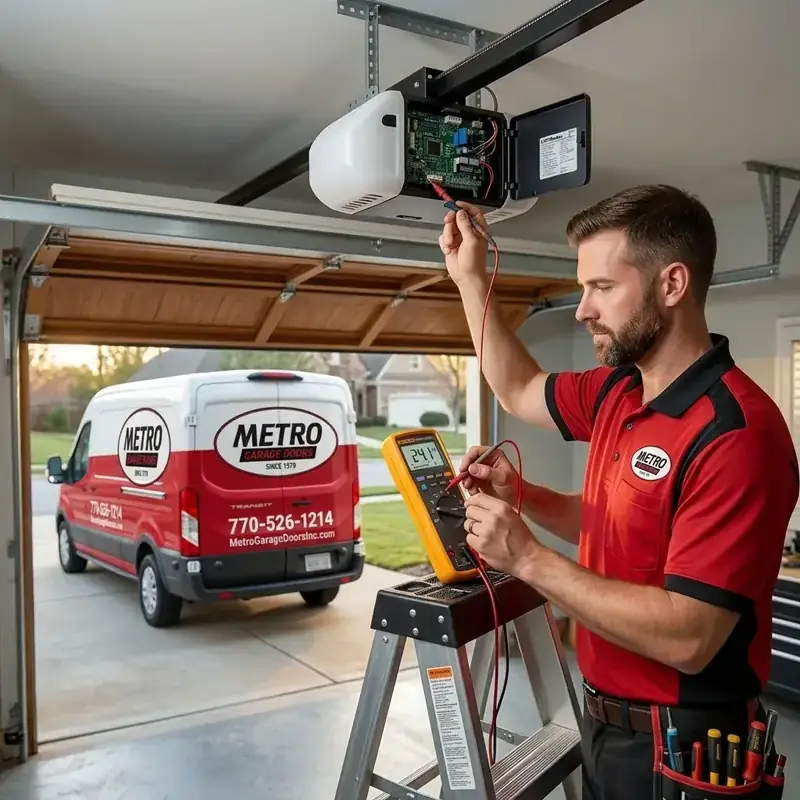
The capacitor, by far the most common opener failure. Roughly 40–60% of opener service calls come back to a degraded run capacitor in the motor. Symptoms: motor hums but the door barely moves or doesn't move at all, slow start, intermittent operation, or an unusual click followed by silence. The capacitor is a small cylindrical component (about the size of a roll of quarters) that supplies the voltage boost the motor needs to break inertia at startup. It's an inexpensive part and takes about 30 minutes to swap, which makes it the cheapest opener repair we do. Most LiftMaster and Genie openers built between 2005 and 2018 use 2–4 standard capacitor specs that we stock on every truck.
Logic board failures, second most common. The logic board is the small circuit board inside the opener housing that orchestrates everything: motor control, sensor input, remote signal decoding, travel limit memory, force-limit safety. Common causes: lightning-induced power surges (Atlanta gets a lot in summer storm season), capacitor failure cascading into the board, water damage in detached carriage-house garages with leaky roofs. Symptoms: opener doesn't respond to remote OR wall button, wall button works but remotes don't, intermittent random operation, or completely dead unit with no indicator lights. Whether the board is replaceable as a unit (LiftMaster, Genie typically yes) or fused into the motor housing (some discontinued brands, at that point full replacement is the call) determines the path forward; we'll quote it in writing on-site.
Drive gear wear, the third common failure mode. Most chain-drive and screw-drive openers use a brass or nylon main drive gear that wears with cycles. Symptoms: motor runs at full speed but the door barely moves or doesn't move (stripped gear), grinding noise during travel, or door drifts down after stopping (worn gear can't hold). We stock common LiftMaster and Genie gears in every truck. Belt-drive and direct-drive jackshaft openers (LiftMaster 8500W, etc.) don't have this failure mode, one reason we recommend them for replacement.
Safety sensors, easy fix, often misdiagnosed. Every opener built since 1993 has a pair of photo-eye sensors near the floor on each side of the door, they detect obstructions and reverse the door. Symptoms when sensors fail or misalign: door opens fine but won't close (reverses immediately), opener LED blinks 10x while attempting to close, door closes only if you hold the wall button down. Real fix is sensor realignment (often the answer when they're just dirty or nudged) or a full sensor pair replacement. DIY attempts often miss that BOTH sensors must show solid LED, one solid, one blinking means the system reads "blocked."
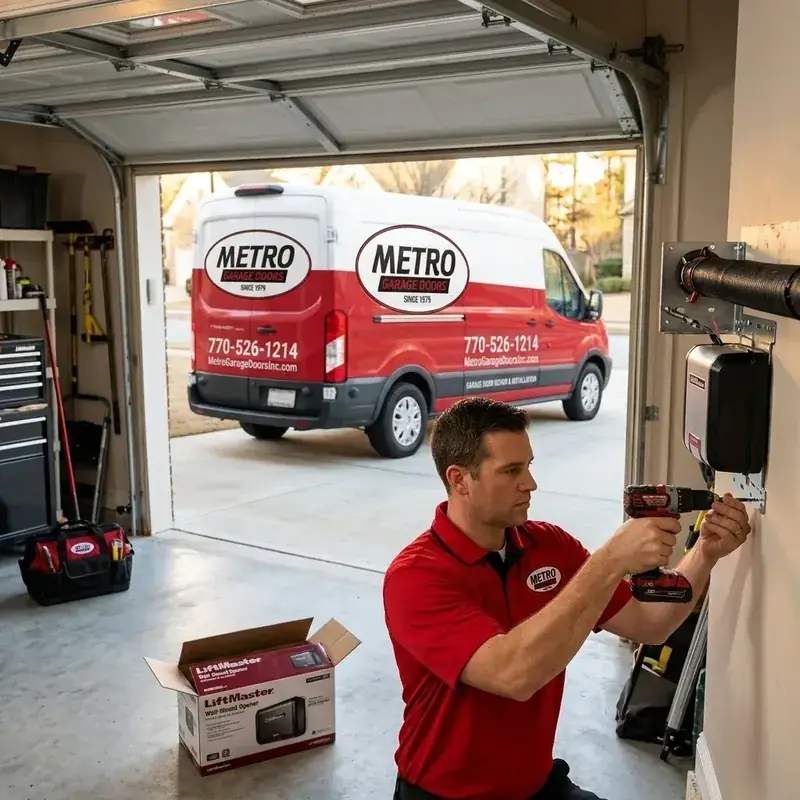
The repair-vs-replace decision. We use three signals on-site. (1) Age: openers under 15 years are usually worth repairing; 18+ years are usually past useful life and parts get hard to source. (2) Failure mode: a single component failure is typically a quick repair; multiple simultaneous failures suggest the unit is at end-of-life. (3) Parts availability: discontinued brands (some early-2000s Genie, older Marantec) may have no replacement parts in stock, at that point repair stops being viable. We diagnose on-site and tell you straight which makes more sense for your specific opener. If the call ends in replacement instead of repair, the diagnostic visit isn't separately billed.