A garage door is the biggest moving thing in the house, and almost every noise it makes is metal asking for lubricant. The right ten-minute pass twice a year keeps a door quiet, cuts wear on rollers and hinges, and costs less than any other maintenance you can do. The wrong can, and standard WD-40 is the wrong can, makes the noise worse within a week. This guide covers which lubricant to buy, the six points it goes on, the parts to leave dry, and the noises that mean a part is past helping, from techs who service doors across metro Atlanta every day.
01The quick answer
If you are standing in the hardware aisle:
- Buy a silicone spray or a white lithium grease labeled for garage doors. Either works; silicone with a straw is the most versatile single can.
- Do not use standard WD-40, 3-in-1 oil, or motor oil. Penetrating oils strip lubricant, and liquid oils drip and gum up in Georgia heat.
- Six points get lubricant: springs, hinges, roller bearings, end bearing plates, the lock, and the opener rail if you have a chain or screw drive.
- Tracks stay dry. Clean them with a damp cloth, never spray them.
- Twice a year, about ten minutes per door, with the door down and the opener unplugged.
02Silicone, lithium grease, or WD-40
Garage door parts move slowly and carry real weight, which calls for a lubricant that stays put and does not swallow dust. That rules the household cans in or out like this:
| Product | Verdict | Where it belongs |
|---|---|---|
| Garage door silicone spray | Recommended | Roller bearings, spring coils, hinge pivots, weather seal. The straw reaches inside bearings, it dries to a film that does not gum, and it is safe on nylon and vinyl. |
| White lithium grease | Recommended | Metal-to-metal contact: steel hinges, end bearing plates, lock mechanisms, chain-drive rail, screw-drive screw. Thicker film, longer life, attracts a little more dust. |
| WD-40 Multi-Use (the classic can) | No | It is a penetrating oil and water displacer, not a lubricant. It dissolves existing grease, then leaves a film that collects grit. Use it to free a rusted bolt, then lubricate properly. |
| WD-40 Specialist silicone or lithium | Fine | These are true silicone spray and white lithium grease that share the brand. Judge the can by the formula, not the logo. |
| 3-in-1 oil, motor oil, cooking spray | No | Liquid oils run off vertical parts, drip on the car, and bake into varnish in a hot garage. |
| Bearing grease from a tub | Sparingly | Torsion-bar bearings on a service visit. Too heavy for anything a homeowner needs to touch, and never in the tracks. |
One can of each, silicone and lithium, covers every door in the house and lasts years. If you only buy one, buy the silicone spray with a straw.
03Where to spray garage door lubricant: the six points
Work top-down with the door closed. Every part named here is mapped with photos in our garage door anatomy guide if you want to see what you are aiming at.
| Point | Lubricant | How |
|---|---|---|
| 1. Springs | Silicone or lithium spray | A light pass across the torsion spring coils above the door (or extension springs beside the tracks). Enough to coat, then wipe drips. A dry spring creaks as it winds and rusts faster. |
| 2. Hinges | Lithium or silicone | One shot at each pivot point where the hinge knuckle turns, every hinge, both sides. Plastic hinges get silicone only. |
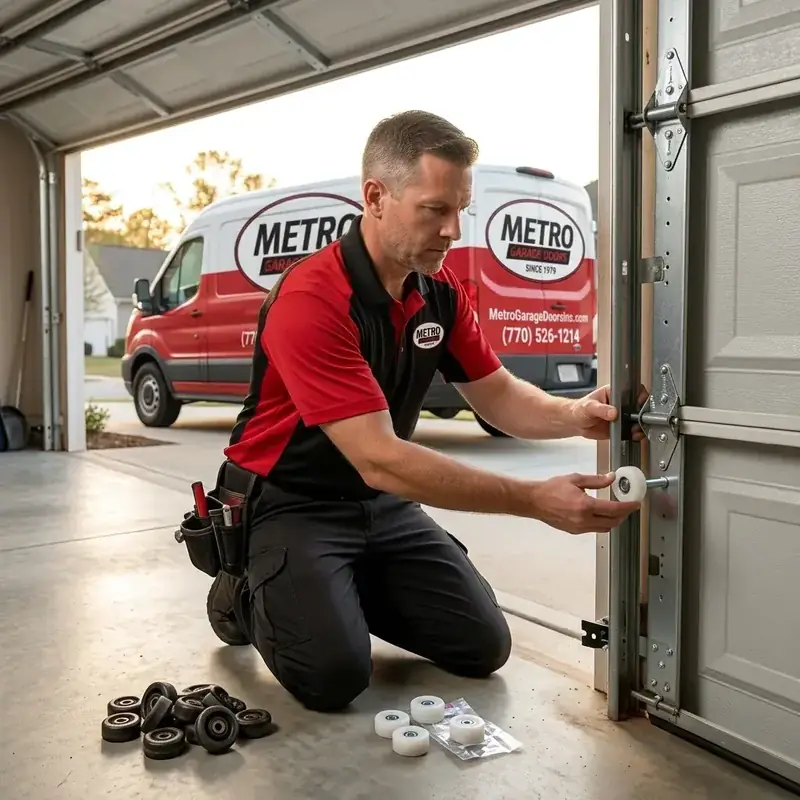
| 3. Rollers | Silicone, into the bearing | Spray the straw into the exposed bearing race where the wheel meets the stem. Sealed nylon rollers get a shot on the stem only. Keep it off the roller tread and out of the track. |
| 4. End bearing plates | Silicone or lithium | The round bearings the torsion bar spins in, one at each end above the door and a center bearing on wide doors. Spray into the bearing with the door at rest, then cycle the door to work it in; keep fingers clear of the drums and cables at either end of the bar. |
| 5. Lock and slide bolts | Lithium; graphite in keyed cylinders | The slide bolt, its keeper, and the armbar pivots. A keyed cylinder prefers graphite or a dry silicone shot; grease in a tumbler collects grit. |
| 6. Opener rail | Depends on drive | Chain drive: lithium on top of the rail where the trolley slides. Screw drive: lithium along the screw. Belt drive: nothing at all. |
04What to leave dry
Half of doing this right is knowing what not to spray:
- The tracks. Rollers are meant to roll through a dry track. Lubricant in the track gathers dust and pollen into a paste, rollers start skating instead of rolling, and nylon treads wear flat. Wipe tracks out with a damp cloth and dry them.
- Nylon roller treads. The bearing gets lubricant; the wheel surface never does.
- The belt on a belt-drive opener. Any lubricant degrades the belt and makes the trolley slip.
- The cables. Lift cables are inspected, not lubricated. Oil on a cable hides fraying and attracts grit into the strands. If a cable is rusty or fraying, that is a cable replacement, not a maintenance item.
- The photo-eye sensors. Overspray on a sensor lens reads as a blocked beam. If the door stops closing after a lubrication session, wipe the lenses first; our sensor alignment guide covers the rest.
- The weather seal exception. The one non-metal part that benefits: a thin silicone wipe keeps the rubber bottom seal from sticking to a cold slab and slows UV hardening. Details in our bottom seal guide.
05How to lube a garage door, step by step
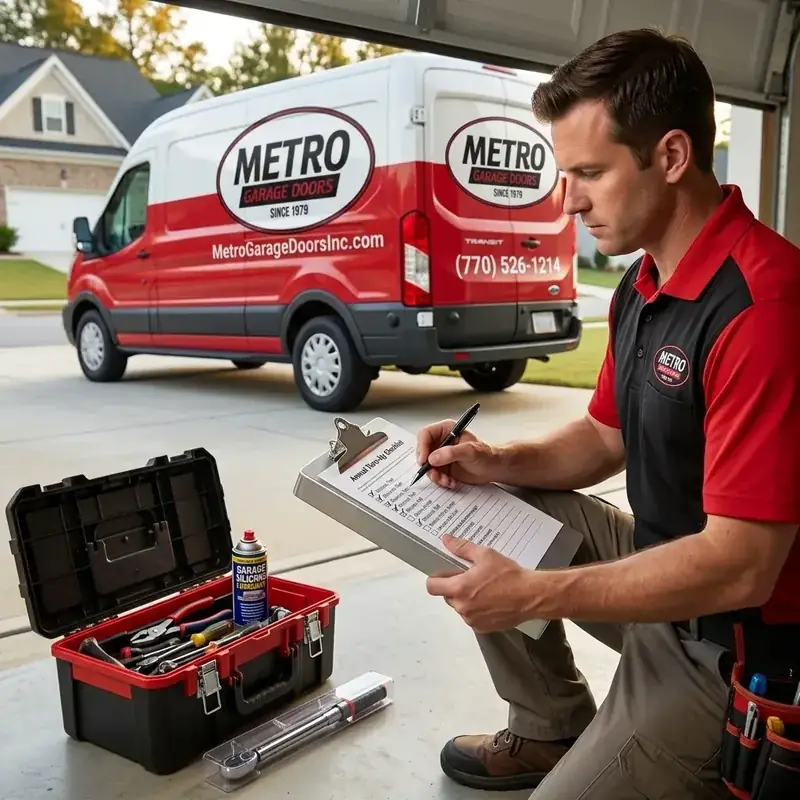
Lubing a garage door takes ten minutes, with no tools beyond the cans, a rag, and a step ladder.
- Close the door and unplug the opener. You will have fingers near hinges and rollers; the door must not move under power.
- Wipe the tracks. Damp cloth, then dry. You are cleaning, not lubricating. Stubborn gunk comes off with a little dish soap and water.
- Work the six points top-down: springs first, then end bearing plates, then down each side doing hinges and roller bearings, then the lock hardware. Top-down means drips land on parts you have not done yet instead of parts you have.
- Do the opener rail per your drive type from the table above. While you are up there, check the rail hardware is snug.
- Plug back in and run the door through three or four full cycles. The movement spreads the lubricant through the bearings, and the noise change tells you immediately what worked.
- Wipe the excess. Anything dripping will end up on the car or collecting dust. A rag pass over the hinge line and the floor under the springs finishes the job.
While the ladder is out, look at the rest of the hardware: cracked hinge knuckles, frayed cable strands, a roller sitting crooked on its stem. Ten seconds of looking during a lubrication pass is how small hardware problems get caught while they are still a cheap part instead of a bent track.
06How often, and what Georgia adds
The standard schedule is every six months: once in spring, once in fall, matched to the two seasons that stress the door. A busy family door cycles about 1,500 times a year, and a light silicone film is good for roughly that half-year of duty. Doors that work harder, a busy family garage or a door doubling as the front door, deserve a quarterly squeak check even if the full pass stays twice yearly.
Metro Atlanta adds three local wrinkles:
- Pollen season. The yellow film that coats every car in April settles in the tracks too, which is exactly why tracks must stay dry: pollen plus lubricant is grinding paste. Wipe tracks after peak pollen, every spring.
- Summer heat. A west-facing garage runs decades of afternoons over 100 degrees inside. Liquid oils varnish in that heat; silicone and lithium films handle it, which is most of why they are the recommendation.
- Humidity. Springs and bare-steel hardware rust year-round here. The film a lubrication pass leaves is also rust protection, and a spring that stays coated lasts measurably longer than one left bare. Spring life and the cycle math are covered in our spring size chart guide and on our spring replacement page.
07Which noise means which part
Lubricant is also a diagnostic: what changes after a pass tells you what the noise was.
- Squeaking or chirping that tracks the door's movement: dry hinges or roller bearings. This is the noise lubrication cures completely.
- A creak or groan as the door starts moving: dry torsion spring coils binding against each other. Silicone on the coils quiets it; a spring that also shows a visible gap or stretch is at end of life.
- Grinding or chattering from a roller that lubrication only dulls: the bearing is shot or the tread has a flat spot. That roller is done; see roller replacement.
- Rattling over bumps in travel: loose hinge or track-bracket hardware. Snug the bolts; lubricant has no opinion here.
- Humming, straining, or grinding from the opener head while the door itself runs quiet by hand: the opener's gear or drive. Our opener troubleshooting guide takes it from there.
- A single loud bang from the garage, then a door too heavy to lift: a snapped torsion spring, not a lubrication topic. Stop and call; the door should not be operated at all.
08When lubricant will not fix it
A can of silicone quiets a healthy door. It does not repair a worn one, and three situations mean the maintenance window has closed:
- The noise returns within days. A part that eats its lubricant that fast has a failed bearing or a wear surface past saving. Re-spraying weekly just delays the replacement.
- The door is loud and heavy. A door that screeches and takes effort to lift by hand has a spring problem, and spring work is the one job we flatly tell homeowners not to touch. A wound torsion spring stores enough energy to break a hand.
- The door binds, jerks, or sits crooked. That is track alignment, a failing cable, or a worn drum, not friction. Running a door that binds makes each cycle more expensive than the last. The full symptom walk-through is in our won't open or close guide.
The honest framing: lubrication is the cheapest thing anyone can do for a garage door, and Metro would rather teach it than sell it. The parts it cannot save, springs, bearings, cables, rollers, are exactly what the annual tune-up exists to catch early, with every price quoted in writing before work begins. Metro has serviced metro Atlanta's doors since 1979 from Douglasville and Alpharetta, with W-2 Metro techs and never a subcontractor.
FAQ
What is the best garage door lubricant?
A silicone spray or white lithium grease labeled for garage doors. Silicone is the better all-rounder: it reaches into roller bearings and spring coils through a straw, dries without gumming, and is safe on the nylon and vinyl parts a garage door is full of. White lithium grease carries a thicker film and lasts longer on slow metal-to-metal contact like hinge pivots and bearing plates. Plenty of doors get by on either one alone; the combination of silicone for bearings and springs plus lithium for hinges is what most techs run on the truck.
Can I use WD-40 on my garage door?
Not the classic blue-and-yellow can. WD-40 Multi-Use is a penetrating oil and water displacer, not a lubricant: it strips whatever grease the part had, leaves a thin film that collects grit, and the noise comes back in days. It is the right tool for freeing a rusted bolt, and that is the only job it should do on a garage door. The same company sells a WD-40 Specialist silicone spray and a white lithium grease, and both of those are fine; it is the formula that matters, not the brand.
How often should I lubricate a garage door?
Every six months for a door on daily duty, so a spring pass and a fall pass. A busy door runs around 1,500 cycles a year, and six months is about how long a light silicone film survives that. A door that gets used a few times a week can stretch to once a year. If the door is squeaking ahead of schedule, lubricate when it squeaks; noise is the part asking early.
Should I lubricate garage door tracks?
No. Tracks are a guide surface, not a bearing surface: the rollers are meant to roll through them dry. Lubricant in the track collects dust and pollen into a paste that makes rollers slide instead of roll, which wears flat spots into nylon treads. Clean the tracks with a damp cloth and keep every spray away from them. If a roller chatters in a clean track, the roller or its bearing is worn, which is a replacement, not a lubrication.
Is there a garage door track grease I should be using?
Products sold as "garage door track lubricant" exist, and they are fine, as long as they go where a garage door lubricant belongs: into the roller bearings and onto the hinge pivots, not along the rail the rollers ride in. Read the can and it will say the same thing in smaller print. A door that drags or chatters through a clean, dry track has a worn roller or a bent track section, and no product fixes that. If you want one purchase, a garage door silicone spray with a straw covers every point on this page.
Do I lubricate the opener chain, belt, or screw?
It depends on the drive. A chain drive gets a light coat of white lithium grease on the top of the rail where the trolley slides, and most manufacturers say the chain itself needs nothing beyond that. A belt drive gets no lubricant anywhere; anything on the belt shortens its life. A screw drive gets white lithium grease along the screw inside the rail, usually once a year. When in doubt, the owner's manual for your opener model settles it in one page.
I lubricated everything and the door is still loud. Now what?
Then the noise is wear, not dryness. The usual suspects in order: rollers with worn bearings or flat-spotted treads, loose hinge or track hardware that lets parts hammer, a spring at the end of its cycle life, or the opener itself. Run the door by hand with the opener release pulled: if it is quiet by hand and loud under power, the opener is the noise. Our troubleshooting guide walks the full diagnosis, and a tune-up visit pins it down in one trip.
Does Metro lubricate garage doors?
Yes. Full-door lubrication is on the 22-point checklist for every Metro annual tune-up, along with spring tension, cable, roller, and safety checks, and we carry silicone and lithium products on every truck. It is the cheapest service we sell and the one that prevents the most repair calls. Call (770) 526-1214 or book online from anywhere in metro Atlanta.