Springs are rated by cycles, not years. One cycle = one open + one close. The standard torsion spring shipped with most builder-grade doors is rated for 10,000 cycles. At typical residential use of 1–2 cycles per day, that's roughly 10–15 years of life. Heavy-cycle households (5+ cycles per day, common with multiple drivers, work-from-home, or kids in and out) burn through standard springs in 5–7 years. Atlanta humidity and lake-adjacent garages (Acworth, Lake Allatoona, Sweetwater Creek) accelerate corrosion and shorten lifespan further.
Why both springs always go in pairs. When one spring snaps, the other has experienced the same wear, the same Georgia humidity, and the same number of cycles. The unbroken spring is typically days or weeks behind the broken one, replacing only the broken one means a second emergency call inside the year, plus the door operates with mismatched-tension springs in between (which damages the opener motor and rollers as the door binds). The labor on a one-spring vs. two-spring call is essentially the same; the parts cost difference is tiny relative to a second service trip.
Standard 10,000-cycle vs. high-cycle 25,000-rated springs. High-cycle springs use heavier-gauge wire and more robust paint or galvanized coatings. They add a small per-spring premium and last 2.5x longer. For most Atlanta households that's a paid-back upgrade well before the second decade, especially after a first-spring failure, since you're already paying the labor. Heavy-cycle households and lake-adjacent homes get the most ROI from the upgrade. We carry both inventories on every truck.
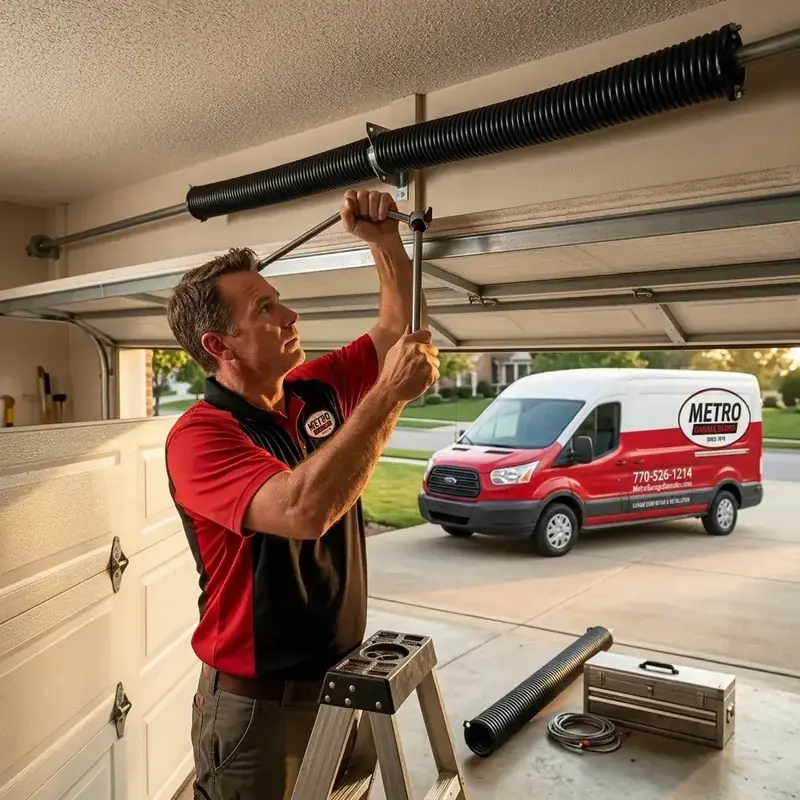
Why DIY spring replacement is dangerous. A wound torsion spring stores roughly 200 lbs of stored tension. When the winding bar slips during a DIY attempt, the spring releases that tension explosively in a fraction of a second. DIY winding accidents send people to the ER every year. Spring sizing also requires matching to your door's weight to within a few pounds, getting it wrong tears the door, the rollers, and the opener apart over the next year of operation, and voids the manufacturer warranty.
Our process. Block the door with vise grips, secure the rollers, wind down the broken spring's residual tension carefully, remove both springs, install the new pair, wind to spec turns based on your door's weight + travel height, balance-test (the door should hold mid-travel without the opener), lubricate the new coils with a non-residue silicone, and demonstrate. From arrival to handoff: typically 60–90 minutes for a single-door, 90–120 for a double.