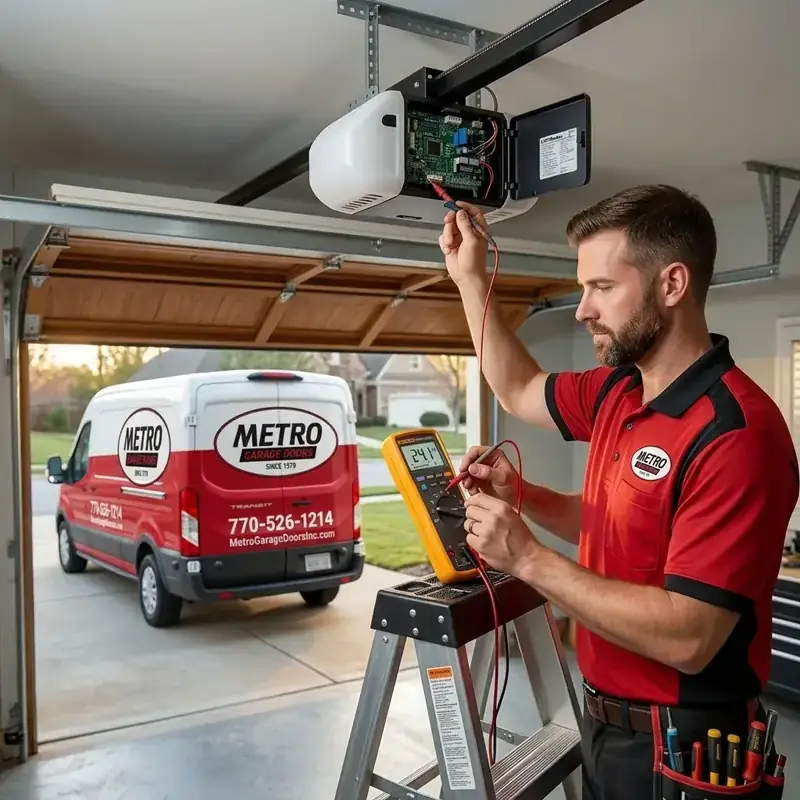
A garage door system hides up to four different batteries: a coin cell in each remote, a 9 volt in the keypad, a sealed 12 volt pack in openers with battery backup, and, on the oldest remotes still in service, a battery type that has not been common since the Braves played at Fulton County Stadium. This guide lists the battery for each device by brand and model, the replacement steps, how long each one lasts, and the symptoms that tell you a battery is dying before it strands the door. It also covers the one battery question that is really an opener question, because a fresh cell fixes nothing when the logic board is the problem.
01The quick answer
- Remote: a CR2032 3 volt lithium coin cell in nearly every LiftMaster, Chamberlain, Genie, and Craftsman remote made since about 2011. Thin keychain remotes sometimes take the slimmer CR2016.
- Keypad: one 9 volt alkaline in most LiftMaster and Chamberlain keypads; some Genie models take AAA cells. The type is stamped inside the cover.
- Battery backup: a 12 volt, 4.5 to 5 Ah sealed lead acid pack (part 485LM on most LiftMaster and Chamberlain models). Replace it when the opener starts beeping, roughly every 2 to 3 years.
- The opener head: no battery. It runs on the outlet, and every code it has learned is stored in permanent memory, so changing any battery never erases programming.
- Remotes from the 1990s and early 2000s: usually a rectangular 9 volt or a small cylindrical 12 volt A23. The type is molded into the case.
02Which battery each part takes
Five devices, four batteries, and one deliberate absence. Life estimates assume a two-car household using the door a few times a day, with the keypad outdoors in Georgia weather.
| Device | Battery | Typical life | First sign it is dying |
|---|---|---|---|
| Remote, 2011 or newer | CR2032 coin cell | 3 to 5 years | Range shrinks; works only near the door |
| Keychain mini remote | CR2032 or CR2016 | 2 to 4 years | Needs two or three presses |
| Remote, 1990s to 2000s | 9V or A23 12V | 1 to 3 years | Intermittent response |
| Wireless keypad | 9V alkaline (some Genie: AAA) | 1 to 2 years | Dim backlight, repeat presses, cold-morning failures |
| Battery backup pack | 12V 4.5 to 5 Ah sealed lead acid | 2 to 3 years | Opener beeps, battery LED turns orange or red |
| Wall button or console | None, hardwired | Life of the opener | Not a battery problem if it fails |
The wall console matters as a diagnostic, not a battery holder: because it has no battery and no radio, a door that obeys the wall button but ignores every remote has a battery or radio problem, and a door that ignores the wall button too has an opener problem.
03Remote batteries by brand and model
The industry quietly standardized on the CR2032 over the last decade and a half, which makes this table shorter than it would have been in 2005. When in doubt, open the case: the battery type is printed on the cell that is already in there.
| Remote | Battery |
|---|---|
| LiftMaster 893MAX, 895MAX visor remotes | CR2032 |
| LiftMaster 890MAX keychain mini | CR2032 |
| LiftMaster 371LM, 372LM, 373LM | CR2032 |
| Chamberlain 953EV / 953EST, 956EV | CR2032 |
| Chamberlain KLIK universal clickers | CR2032 |
| Genie GITR-3, G3T-R, GM3T | CR2032 |
| Craftsman 3-button (Chamberlain built) | CR2032 |
| 1990s dip-switch and early rolling code remotes | 9V or A23 12V, molded into the case |
Changing it takes about a minute. Pry the case open at the seam with a coin or a small flathead, or slide the visor clip off on models where the clip locks the case. Note which face of the old cell points up, usually the plus side, and seat the new one the same way. Snap the case shut and press the button. The remote keeps its code through the swap, so there is nothing to reprogram. Buy name-brand cells in date-coded packaging; a coin cell that sat in a drawer for five years arrives half dead.
04Keypad batteries
The wireless keypad on the door frame works harder than any remote: it lives outside through Atlanta summers and the occasional ice storm, and its backlight and radio pull from one battery. Most models, including the LiftMaster 877MAX and 877LM and the Chamberlain 940EV, take a single 9 volt alkaline behind the sliding front cover. Some Genie keypads take AAA cells instead; the compartment tells you.
- Slide the cover up and off. The battery sits in a snap connector or a molded cradle behind it.
- Use a fresh alkaline, or a lithium 9 volt if the keypad faces north. Lithium cells hold voltage in the cold far better, and cold mornings are exactly when a marginal alkaline quits.
- Your PIN survives. The code is stored in the keypad's memory, not the battery, so there is nothing to re-enter after the swap.
- Test with the door in sight. Enter the PIN, press enter, and watch the door respond before you snap the cover back on.
A keypad that still acts up on a fresh battery usually has a worn button membrane or corrosion on the battery contacts, and at ten-plus years old is often cheaper to replace than to fight. That call is part of any opener service visit.
05The backup battery
Openers sold in the last several years increasingly include battery backup, and California has required it on new openers since 2019. Georgia has no such law, but a metro Atlanta summer delivers enough storm outages to make the backup pack the single most useful thing an opener can carry: it is the difference between a car that leaves the garage during an outage and one that does not.
- What it is: a sealed lead acid pack, 12 volts at 4.5 to 5 Ah, sold as part 485LM for most LiftMaster and Chamberlain battery backup models. It sits behind the light lens or a side compartment on the powerhead.
- What it delivers: roughly 20 open and close cycles in the first 24 hours of an outage on a healthy pack, with slower, quieter operation than wall power.
- When to replace it: when the opener beeps about every 30 seconds and the battery LED shows orange or red, the pack no longer holds a charge. Expect that after 2 to 3 years, sooner if it has carried the door through several outages.
- How to replace it: unplug the opener, open the compartment, unclip the red and black spade terminals, clip them to the new pack red to red and black to black, close up, plug in, and give it a day or two to reach full charge.
- Where the old one goes: a battery retailer or hazardous waste drop-off. It is a lead battery; it does not go in household trash.
If your opener predates battery backup entirely, the honest fix is not a bolt-on: it is one of the criteria for a new opener, alongside a quieter drive and modern safety hardware. Metro carries battery backup models from LiftMaster and quotes the swap in writing before any work begins.
06Why the opener itself has no battery
The powerhead on the ceiling plugs into a standard outlet and keeps every learned remote, keypad code, and travel limit in nonvolatile memory, the same kind of storage a flash drive uses. Pull the plug for a week and it forgets nothing. Three practical consequences follow:
- Changing any battery never erases programming. Not the remote's, not the keypad's, not the backup pack's. If a remote stops working after a battery swap, something else is wrong.
- A power outage does not require a reset. When the lights come back, the opener picks up where it left off. The full outage sequence, including the red release cord and re-engaging the trolley, is in our reset guide.
- A dead outlet mimics a dead opener. Openers share garage circuits with freezers and shop tools, and a tripped GFCI upstream is a classic. Check the outlet with a phone charger before assuming the worst; the rest of that ladder is in the troubleshooting guide.
07When a new battery is not the fix
Batteries are the cheap, satisfying answer, which is exactly why they get blamed for problems they did not cause. The pattern of what still works tells you where the real fault is.
- Fresh cell, short range. The remote transmits; the opener barely hears it. Check that the antenna wire hangs free below the powerhead rather than tucked against the metal housing, and swap any non-shielded LED bulbs in the opener sockets, which are a documented source of radio interference.
- Fresh cell, must press hard or twice. The button membrane is worn. Remotes are consumables; after a decade the rubber gives out.
- Wall button works, no remote works. The receiver or its logic board is failing. That is a repair visit, not a battery run.
- Nothing works at all. Power, capacitor, gear, or board. A tech isolates it in one visit with the price quoted in writing before work begins.
Metro Garage Doors has serviced openers across metro Atlanta since 1979, with W-2 techs out of Douglasville and Alpharetta and same-day service on most opener repair calls. If the door is down and staying down, call (770) 526-1214 and skip the second trip to the battery aisle.
FAQ
What kind of battery does a garage door opener remote take?
Almost certainly a CR2032, the 3 volt lithium coin cell about the size of a quarter. LiftMaster, Chamberlain, Genie, and Craftsman have all standardized on it for remotes made since roughly 2011, including the visor remotes and most keychain minis. The exceptions are thin keychain remotes that take the slimmer CR2016 and remotes from the 1990s and early 2000s, which often run a rectangular 9 volt or a small 12 volt A23 cylinder. The battery type is molded into the case or printed on the old battery, so open it up and read before you buy.
What size battery goes in a LiftMaster remote?
A single CR2032 coin cell in the current models: the 893MAX and 895MAX visor remotes, the 890MAX keychain mini, and the 371LM, 372LM, and 373LM they replaced. Pop the case at the seam with a coin or small screwdriver, note which side of the old cell faces up, and match it. The remote keeps its programming through the swap, so it works on the door again the moment the new cell seats.
Do I have to reprogram my remote after changing the battery?
No. The remote's code, including the rolling code sync with the opener, is stored in the remote's own permanent memory, not held alive by the battery. Swap the cell and press the button; the door should move. If it does not, the battery is in backwards or dead from the shelf, the contacts are corroded, or the remote lost its pairing for some other reason, in which case one press of the Learn button re-pairs it in under a minute. The steps are in our programming guide.
What battery does a garage door keypad take?
Most wireless keypads, including the LiftMaster 877MAX and 877LM and the Chamberlain 940EV, take one 9 volt alkaline behind the sliding cover. Some Genie models use AAA cells instead; the type is stamped inside the cover. Keypads live outdoors, so they eat batteries faster than remotes, and a cold snap will finish off a cell that was merely weak in October. Your PIN survives the swap, no reprogramming needed.
How long does a garage door opener backup battery last?
Two numbers matter. During an outage, a healthy backup battery is rated for roughly 20 open and close cycles in the first 24 hours. In terms of service life, the sealed lead acid pack lasts about 2 to 3 years, less if it has carried the door through several storms. The opener tells you when it is done: a beep every 30 seconds or so and an orange or red battery light mean the pack will no longer hold a charge and should be replaced even though the opener still runs fine on wall power.
Can I replace the opener backup battery myself?
Yes. Unplug the opener, open the battery compartment, which sits behind the light lens or a side panel on most LiftMaster and Chamberlain battery backup models, unclip the red and black spade terminals from the old pack, and clip them onto the new one, red to red, black to black. Plug the opener back in and give it a day to charge. Take the old sealed pack to a battery retailer or a hazardous waste drop-off; it is lead, and it does not go in the trash. If a ladder is not your idea of a Saturday, a Metro tech swaps it during any annual tune-up.
Why does my remote still not work with a brand new battery?
Start with the simple three: the cell is in upside down, the contacts inside the case are corroded, or the rubber button pad is worn past making contact. If the remote works only from a few feet away, the problem is range, not power: check that the opener's antenna wire hangs free of the motor housing, and know that some non-shielded LED bulbs in the opener light sockets interfere with the radio. If nothing works, including the wall button, the opener itself is the patient, not the batteries. Metro diagnoses openers across metro Atlanta with the repair quoted in writing before work begins. Call (770) 526-1214.