Garage door repair has a real scam problem on Google. Most calls are urgent, the door is stuck, and the homeowner picks the first result that looks local. Some of those results are not local at all. This guide shows the three tricks we hear about most from Atlanta homeowners, and how to check any company in about five minutes.
01Fake map listings
The map pack is the box of three businesses under the map in Google results. Homeowners trust it because it looks like a list of nearby shops. Scammers know that, so they create listings that look local but aren't.
Most fake listings share a few tells:
- A name stuffed with keywords. Think "Best Garage Door Repair Marietta 24/7" instead of a real business name.
- No street address, or an address that turns out to be a mailbox store or an empty lot on Street View.
- Stock photos instead of real trucks, real techs and real jobs.
- A burst of five-star reviews in the same few weeks, with short, vague text and no owner replies.
- A website that names a different company, or no website at all.
One tell alone isn't proof. Plenty of honest companies work from home and hide their address. But three or four together should make you keep scrolling.
02Call centers posing as local companies
Some "local" garage door companies are really lead brokers. They run dozens of city websites and listings, all routing to one call center. The operator takes your details and sells the job to whichever contractor bids for it.
That contractor might be fine. But you never chose them, and you can't check their record before they arrive. The broker also takes a cut, so the price often covers two businesses.
How to tell on the phone:
- They answer with something generic, like "Garage door service, how can I help?"
- They can't tell you which company will send the technician.
- The website lists no street address, or one in a different city than the ad.
03The "$29 service call" bait
This is the trick that costs homeowners the most. The ad promises a $19, $29 or $39 service call. That fee rarely covers the cost of the visit. Often, the low fee exists to get a salesperson into your garage.
Here is how it usually goes:
- The tech arrives and finds that "everything" needs replacing: springs, cables, rollers, sometimes the opener.
- The quote comes as one big number, not an itemized list of parts and labor.
- There is pressure to decide now, with a "today only" discount or a warning that the door is unsafe.
- They ask for cash, or a check made out to a person instead of a company.
The safety warning is sometimes true. A garage door weighs 130 to 350 pounds, and a broken spring can drop it fast. Get a second opinion, but don't use the door until it's checked.
A broken spring is a real and common repair. Our spring repair page explains what the job involves. But a bait-and-switch crew will often sell a full rebuild when one spring and a tune-up would do. If you want to check what you have first, our spring size chart shows how springs are measured and sized.
04Sponsored vs. Google Verified: what the labels mean
The top of a Google search often shows two kinds of ads. Each label means something different.
- "Sponsored" search ads are text ads that look like normal results. Almost any business can buy one. The label tells you they paid, not that anyone checked them.
- Local Services Ads often appear above those and often carry a "Google Verified" badge. To get it, a business goes through Google's screening. Depending on the trade and the area, that can include license, insurance and background checks.
The two ad types also charge companies differently, which shapes how they compete for your call. Quips, a marketing agency, explains how Local Services Ads differ from regular Google Ads for the businesses that buy them, including the screening and how each one is billed.
A badge is a useful signal, but it isn't a price guarantee. A screened company can still overcharge. Use it as one check among several.
05The five-minute check before you book
You don't need to be an expert to filter out most bad actors. Run these checks on your phone while you wait for a callback:
- Match the name. The listing, the website and the person on the phone should all use the same company name.
- Find the building. Look up the address on Google Maps Street View. You want a real shop or showroom, not a mailbox store.
- Look up the registration. Search the company on the Georgia Secretary of State business search. Check the registration date. A company formed a few weeks ago is a red flag.
- Read reviews across years. Steady reviews over a long time, with owner replies, beat a sudden pile of five-star ratings. Here is what years of real reviews look like.
- Ask who shows up. "Will your own employee come out, or do you send jobs to other companies?" The answer should be quick and clear.
- Ask for proof of insurance. A real company can send you a certificate of liability insurance.
- Get it in writing. Ask for an itemized, written quote before any work starts. Never sign a blank work order.
If a company passes all seven, you're very likely dealing with a real local business.
06If you already hired one
It happens to careful people. The door was stuck, it was late, and the tech seemed friendly. If something feels wrong mid-job, you still have options.
- Stop the work before you agree to anything beyond the original problem.
- Ask for an itemized invoice listing every part and the labor charge separately.
- Pay by credit card if you can. It gives you a way to dispute the charge later.
- Keep the old parts. A "broken" spring or cable that looks fine is useful evidence.
- Report it to the Georgia Attorney General's Consumer Protection Division and the BBB. You can also report the listing to Google.
If your door is still not working after a bad visit, start with our guide to a garage door that won't open or close. It covers the safe checks you can do yourself.
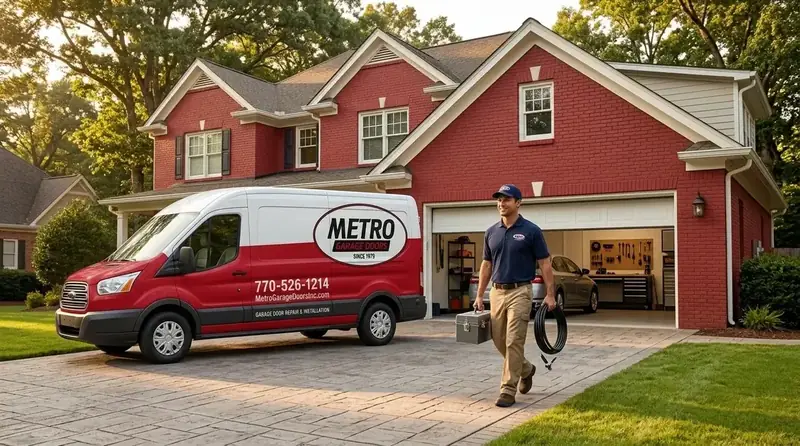
We wrote this because we keep meeting homeowners who were burned once already. Metro has served Atlanta since 1979, from a real showroom in Douglasville, and every tech who comes to your house works for Metro. We never pass jobs to subcontractors. If you're in Marietta, Alpharetta or anywhere else we serve, you can reach a Metro person directly, and you'll know exactly who is coming before the truck pulls in.
FAQ
How can I tell if a garage door company on Google is real?
Check that the business name matches across the listing, the website and the phone call. Look up the street address on Street View, and search the company on the Georgia Secretary of State business search. Real companies have steady reviews over many years, with owner replies.
Is a $29 garage door service call a scam?
Not always, but it is a common bait. A very low service fee often exists to get a salesperson into your garage. The real cost shows up in an inflated repair quote. Ask for an itemized, written quote before any work.
What does the Google Verified badge mean?
It means the business went through Google's screening for Local Services Ads. Depending on the trade and area, that can include license, insurance and background checks. It is a useful trust signal, but it does not guarantee fair pricing.
Why does the garage door company that shows up have a different name?
You probably called a lead broker. These call centers run local-looking websites and listings, then sell your job to another contractor. Ask who will send the technician before you book, and check that company separately.
What should I do if I think a garage door company overcharged me?
Ask for an itemized invoice, keep the old parts, and dispute the charge with your card issuer if you paid by card. Report the company to the Georgia Attorney General's Consumer Protection Division, the BBB and Google.