Every torsion spring on a residential garage door comes down to four measurements. Once you have them, the size chart does the rest. This guide gives the wire size chart by 10 and 20 coil measurements and the inside diameters and lengths springs come in. It explains what the DASMA color codes encode, how to read wind direction, and how many years each cycle rating buys. It is written for homeowners who want to understand what a tech measures above their door. It is also honest about the one job that should stay with the tech: winding a spring under tension.
01The quick answer
- Four numbers define a torsion spring: wire size, inside diameter, overall length, and wind direction.
- Wire size: measure 20 coils and divide by 20. Residential springs run about 0.192 to 0.295 inch, with 0.207 to 0.273 covering most doors.
- Inside diameter: 1 3/4 or 2 inches on nearly every residential door; 2 1/4 and 2 5/8 show up on heavy and commercial doors.
- Length: the coiled body without the cones, typically 20 to 40 inches on residential springs.
- Wind: on most springs a red cone means right-wind and a black cone means left-wind; confirm by mounting position. On a two-spring door the left-wind spring sits on the right of the center bracket, seen from inside.
- Life: a standard 10,000-cycle spring lasts about 14 years at two cycles a day, about 7 years at a busy four; a 25,000-cycle spring about 2.5 times longer.
- Measure only a broken or unwound spring. A wound spring is never touched by hand.
02The four numbers on a torsion spring
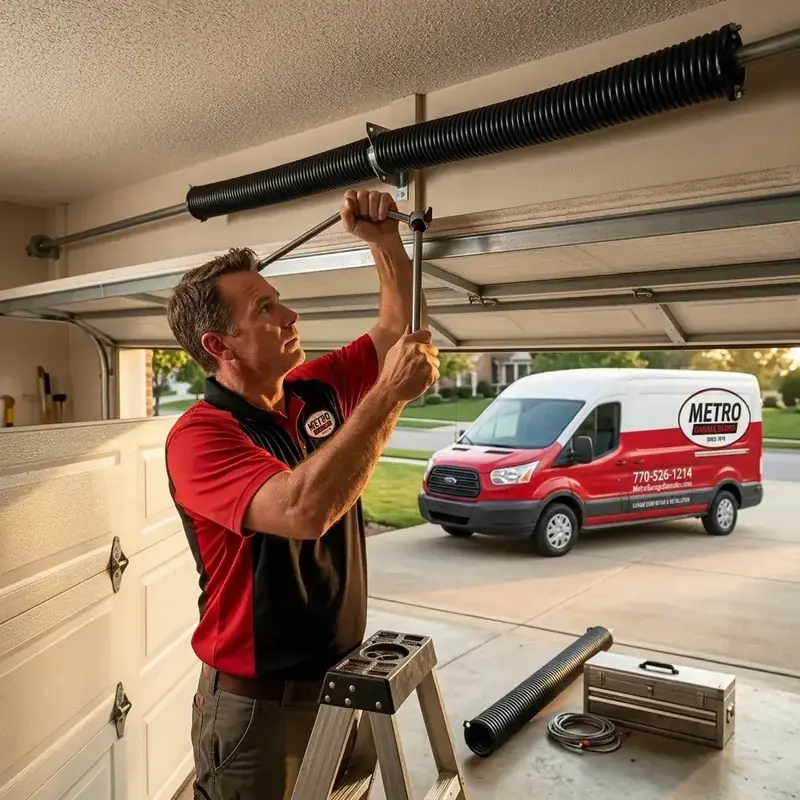
A torsion spring sits on a steel tube above the door and twists to lift it. Its lifting force comes from how thick the wire is, how wide the coil is, and how long the coil runs. Those three numbers travel together. The fourth, wind direction, decides which end of the tube the spring belongs on. Our anatomy guide shows where each part lives. Here is what each measurement means and the range you will see on a house door.
| Measurement | What it is | Typical residential range | How you get it |
|---|---|---|---|
| Wire size | Diameter of the steel wire the coil is wound from | 0.192 to 0.295 in. | Measure 10 or 20 coils, read the chart |
| Inside diameter | Width of the open center of the coil, where the tube passes through | 1 3/4 in. or 2 in. | Tape across the inside of the coil end |
| Length | The coiled body, cone to cone, with no tension on it | 20 to 40 in. | Tape along the coils, cones excluded |
| Wind | Direction the coil spirals, which sets which side of the door it mounts on | Left or right | Cone color, or mounting position |
Two of those numbers are not printed or stamped anywhere, which is why measuring matters. Some springs carry a tag with the full spec. Some carry only a color stripe, and many builder-grade springs carry neither.
03Wire size chart, by 10 and 20 coils
Wire size is the measurement that matters most. The tape method works because coils sit tight against each other, so 20 coils of 0.225 wire measure 4 1/2 inches every time. Twenty coils gives a more reliable read than ten, since a small error is divided further. Find your measurement in the middle columns and read the wire size across.
| Wire size | 10 coils | 20 coils | DASMA color | Commonly found on |
|---|---|---|---|---|
| 0.192 | 1 15/16 in. | 3 13/16 in. | Orange | Light single-car doors |
| 0.207 | 2 1/16 in. | 4 1/8 in. | Yellow | Single-car steel doors, 8 and 9 ft wide |
| 0.218 | 2 3/16 in. | 4 3/8 in. | White | Single-car doors, insulated singles |
| 0.225 | 2 1/4 in. | 4 1/2 in. | Red | Heavier singles, light doubles |
| 0.234 | 2 5/16 in. | 4 11/16 in. | Brown | 16 by 7 ft doubles, non-insulated |
| 0.243 | 2 7/16 in. | 4 7/8 in. | Green | 16 by 7 ft doubles |
| 0.250 | 2 1/2 in. | 5 in. | Gold | Insulated doubles |
| 0.262 | 2 5/8 in. | 5 1/4 in. | Blue | Heavy insulated doubles, 8 ft tall doors |
| 0.273 | 2 3/4 in. | 5 7/16 in. | Orange | Wood and heavy carriage doubles |
| 0.283 | 2 13/16 in. | 5 11/16 in. | Light blue | Oversized and solid wood doors |
| 0.295 | 2 15/16 in. | 5 7/8 in. | White | Very heavy residential, light commercial |
The last column is a pattern from the field, not a rule. Two doors of the same width can need different wire. One may be a bare steel pan and the other a two-inch insulated sandwich with windows. That is why a tech sizes from the door's weight, not its size. Our door weight guide has the weight ranges by type.
04How to measure a torsion spring
Do this on a spring that has snapped, or on one a technician has unwound and told you is safe. A wound spring stores roughly 200 pounds of force behind two set screws, and nothing in this section is worth testing that.
- Confirm the tension is off. A broken spring shows a gap of an inch or more in the coil and hangs slack; that spring is safe to handle. An intact spring with no gap is wound and stays untouched.
- Wire size: measure 20 coils. Lay a tape along the coil body, mark the start of one coil, count 20, and read the length. Find it in the chart above. If the coils are rusty or uneven, measure two different sections and use the one that lands cleanly on a chart value.
- Inside diameter: measure across the open end. Tape from inside edge to inside edge of the coil, not across the outside. Anything reading 1 3/4 or 2 inches is standard; 2 1/4 and up is a heavy-door spring.
- Length: measure the body without the cones. Cone to cone along the coils. On a broken spring, measure the two pieces separately and add them; the gap where the wire broke is not part of the length.
- Wind: read the cone, then the position. On most springs a red winding cone is right-wind and a black one is left-wind. On a two-spring door, stand inside looking at the door. The left-wind spring mounts on the right side of the center bracket, and the right-wind on the left. Write down which side yours came from.
- Write all four down before anything moves. Wire, inside diameter, length, wind. That line is the part number of your spring, and it is what a supplier or a tech needs to match it.
05What the color codes mean
Springs carry two color systems and homeowners regularly mix them up.
- Winding cone color usually marks wind direction. On most springs a red cone is right-wind and a black cone is left-wind. Manufacturers are not uniform, so confirm the wind by which side of the center bracket the spring mounts on.
- A stripe or paint on the coil body is wire size, per the DASMA color code (TDS-171). The colors do not follow a simple repeating order, and one color can mark more than one size: orange is used for both 0.192 and 0.273 wire. The stripe narrows the answer; the 20-coil measurement settles it.
- Extension springs are colored by lift weight, not wire. On the stretched springs that run beside the horizontal tracks, the paint on the end loop encodes the door weight the spring is rated to lift. Read it against the manufacturer's chart, or weigh the door, which is the number that actually matters.
- Galvanized and coated springs may carry no stripe at all. Coated springs are common on high-cycle upgrades. With no stripe, measure.
06How long springs last, by rating
Springs are rated in cycles, one open plus one close, and the rating is the whole story on lifespan. Years only follow once you know how often the door moves. A door used mostly for the car sees one or two cycles a day. A household that leaves and comes home through the garage, plus a delivery or two, lands around four. A two-car family with kids on bikes doubles that.
| Spring rating | 2 cycles a day | 4 cycles a day | 8 cycles a day |
|---|---|---|---|
| 10,000 cycles (standard) | About 14 years | About 7 years | 3 to 4 years |
| 15,000 cycles | About 20 years | About 10 years | About 5 years |
| 25,000 cycles (high-cycle) | About 34 years | About 17 years | 8 to 9 years |
Those are rated cycles under clean conditions, a life expectancy rather than a promise. Georgia adds humidity, which rusts bare wire and pits the surface where fatigue cracks start. A spring that is never lubricated fails early in the range. One that gets a silicone pass twice a year, per our lubricant guide, sits at the top of it. The cheapest life extension on any door is the ten-minute lubrication that most garages never get.
A high-cycle spring is not a different material. It is a longer spring, or a heavier wire, or both, delivering the same lifting force with less stress on each coil. That is why a high-cycle conversion changes the numbers on the chart. The replacement spring is deliberately not the same size as the original, and a tech converts the spec so the door stays balanced. Metro installs both standard and 25,000-cycle springs, sized on site. The tradeoffs are on our spring replacement page.
07Matching the spring to the door
A spring is chosen to balance a specific door: its weight, its height, and the cable drums that turn spring rotation into lift. With a correctly sized pair, the door hangs still halfway up with the opener disconnected. It lifts with one hand and closes without slamming. The opener is designed to add the last push, not to carry the door. Every pound the springs miss is a pound the opener's gear absorbs on every cycle.
- Weight comes first. A tech weighs the door on a bathroom scale with the springs unwound, or works from the manufacturer's spec for the exact panel and insulation combination. Guessing from door size is how doors end up with springs a size off.
- Two springs split the work. On a double door, two springs of the same spec share the load and each one lasts longer. Some builder single-car doors come with one spring. A matched pair is a standard upgrade on a replacement, and the pair uses smaller springs than the single they replace.
- Replace in pairs. The second spring has the same cycle count as the one that broke and is usually weeks behind it. One visit for two springs also keeps the door balanced instead of running on mismatched tension.
- Different size, same force. If the exact original is unavailable, a tech converts to a spring with the same lifting force, using the wire, diameter, and length relationship. That is routine on a service call and the reason the chart above lists typical uses rather than a formula to follow.
- Winding is the tech's job. A spring is wound a set number of quarter turns based on door height and drum size. Then it is locked with set screws while the winding bars hold it. This is the most dangerous task on a garage door, and the one we always tell homeowners to leave alone.
08Extension springs
Older Atlanta homes and some low-headroom garages use extension springs instead. These are a pair of long stretched springs, one above each horizontal track, that pull the door up through pulleys and cables. They are sized differently and simpler to read.
- Sized by door weight. An extension spring is rated to lift a certain door weight as a pair, and the color on the end loop encodes that rating. The door's actual weight, again, is the number that matters.
- Length follows door height. Standard extension springs are 25 inches unstretched for a 7 foot tall door and 27 inches for an 8 foot door. They stretch by roughly half the door's height when the door is closed.
- Always with safety cables. An extension spring that breaks under tension flies. A steel safety cable threaded through the spring contains it. Any extension spring without one should get one on the next visit.
- Consider converting. When an extension spring fails, a torsion setup gives better balance, longer life, and a safer failure mode. Metro quotes both options in writing on the same visit. The details are on our spring repair page.
Whichever type is above your door, the annual tune-up catches spring fatigue early. Better a scheduled appointment than a car trapped in the garage. Measured a spring and have questions? Send us a message with your four numbers. A tech from our Douglasville or Alpharetta team can tell you what they mean.
FAQ
What size garage door spring do I need?
The one that matches the door's weight and travel. On a replacement, that means the same four numbers as the spring coming off: wire size, inside diameter, length, and wind. Measure the old spring and read the wire size off the chart above, or weigh the door and let the tech size from that. A common 16 by 7 foot double runs a pair of springs in the 0.234 to 0.250 wire range on a 2 inch inside diameter. A single-car door often sits at 0.207 to 0.225. Those are typical, not a rule, because insulation, windows, and door material all change the weight.
How do I measure a garage door torsion spring?
With the tension off, and only then. Lay a tape along the coils and measure the length of 20 coils. Divide by 20 for the wire size, or read it straight from the chart. For example, 4 1/2 inches over 20 coils is a 0.225 wire. Measure the inside diameter across the open end of the coil, not the outside. Measure the overall length of the coiled body without the cones. Then note the wind from the cone color and which side of the center bracket the spring was mounted on.
What do the colors on garage door springs mean?
Two different things. A colored stripe or paint on the coil body is the wire size, following the DASMA color code, so a yellow stripe means 0.207 wire and a red stripe means 0.225. The color of the winding cone at the end tells you the wind: on most springs red is right-wind and black is left-wind. Because the same stripe color appears on more than one wire size, the stripe confirms a measurement rather than replacing it.
How long do garage door springs last?
Springs are rated in cycles, one open and one close, not in years. A standard spring is rated for 10,000 cycles. That is about 14 years at two cycles a day and about 7 years at the four a day a busy family garage sees. A door that opens eight times a day gets 3 to 4 years. High-cycle springs rated for 25,000 cycles last about two and a half times longer. Georgia humidity shortens either one, which is why a coated spring that gets lubricated twice a year outlasts a bare one.
Can I use a different size spring than the original?
Only if it delivers the same lifting force, and that is a calculation, not a guess. A spring's strength is set by wire size, inside diameter, and length together, so a longer spring with a heavier wire can replace a shorter one and turn the door into a high-cycle setup. A spring that is merely close makes the door heavy at the top or slam at the bottom. It wears the opener and can void the door warranty. Conversion tables exist, and a tech uses them on every job. A guess is the one thing to avoid.
Should my door have one spring or two?
Two, on almost any door wide enough for a car, and on every double. Two springs share the load, so each one works less and lasts longer. When one breaks, the other keeps the door from free-falling. Some single-car doors ship from the builder with a single spring to save a few dollars of hardware. Converting to a matched pair is a normal part of a replacement visit, and Metro replaces springs in pairs by default because the second spring is always on the same clock as the first.
Is it safe to measure my spring myself?
Yes on a broken spring, since a snapped spring has already released its tension, and yes on a spring a tech has unwound. Never touch, loosen, or lean a ladder against a wound spring. It stores roughly 200 pounds of force behind two set screws, and a winding cone that lets go can break bones. If the spring is intact and the door is simply heavy or loud, read the color stripe from the ladder and leave the rest to a Metro tech, who measures and sizes it on site. Call (770) 526-1214 anywhere in metro Atlanta.