Every garage door makes noise, but the type of noise is diagnostic. A squeal is dry metal. A grind is a worn wheel or a dying gear. A rattle is loose hardware shaking itself looser. A single gunshot bang is a spring, and that one ends the DIY portion of the evening. This guide decodes each sound the way our techs do, then walks the fixes from a ten-minute lube pass to the full quiet-door setup we install under bedrooms.
01The 60-second version
Most garage door noise comes from three places, and the fixes stack from cheap to permanent:
- Dry hardware. Springs, hinges and roller bearings all need lubricant, and almost nobody applies it. A proper pass with the right spray quiets the average door dramatically. The product choice and the six points are in our lubrication guide.
- Worn steel rollers. Steel wheels in steel track are the sound most people mean by "my door is loud." Sealed-bearing nylon rollers are the single most effective quiet-door upgrade a door can get.
- Loose bolts and a loud opener. Vibration backs track and hinge bolts out over the years, and a chain-drive opener adds its own racket on top. Tightening is free, and a belt-drive swap handles the rest.
If the door is noisy and misbehaving, struggling, reversing, moving crooked, the noise is a symptom rather than the problem. Start with the won't-open-or-close diagnostic instead.
02The sound decoder
Find your noise, then jump to its section:
| Sound | Most likely source | Fix |
|---|---|---|
| Squeak or squeal during travel | Dry hinges, springs or roller bearings | Lubricate, ten minutes |
| Grinding or scraping | Worn or seized rollers dragging in the track | Roller replacement |
| Grinding at the motor, white dust on it | Opener drive gear stripping | Opener repair |
| Rattle or buzzing vibration | Loose track, hinge or opener-rail bolts | Tighten hardware |
| Pop or snap at one spot each cycle | Worn hinge, flat-spotted roller or dry spring coils | Lubricate, then replace the worn part |
| Slapping or clanking overhead | Loose opener chain hitting the rail | Chain tension adjustment |
| One very loud bang, then a heavy door | Broken torsion spring | Technician, same day |
| Straining hum, door barely moves | Spring or balance problem, opener overworking | Technician |
03Squeaking and squealing
The most common noise and the cheapest fix. A garage door has a dozen hinges, ten or more rollers and one or two big springs, all metal moving against metal, and all of it designed to run with a film of lubricant that dried out years ago.
The squeal usually lives in three places: the spring coils flexing against each other, the hinge knuckles at every section joint, and the ball bearings inside each roller. The fix is a garage-door rated silicone or white lithium spray applied to those exact points, not a blast of a water-displacing cleaner at whatever looks shiny. The full walkthrough, including which product to buy and the parts to leave dry, is in our lubricant guide.
Two honest caveats. A squeak that comes back within days usually means the wrong product went on. And hardware that still squeals after two proper passes is generally worn past the point where lubricant helps, which for rollers means the bearings are gone. That is the next section.
04Grinding and scraping
Grinding is wear you can hear. Two versions matter:
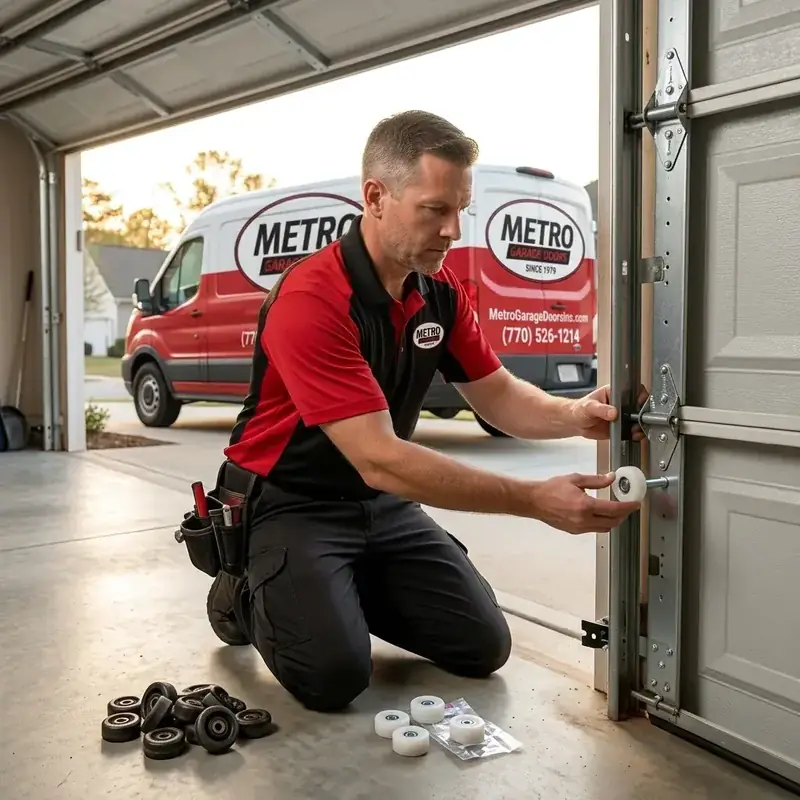
- Grinding along the track during travel. Builder-grade steel rollers carry small open bearings that wear flat, fill with grit, and eventually stop rolling entirely. A seized roller drags through the curve of the track like a shopping-cart wheel, and you hear every inch. Left alone it chews the track lining, stresses the hinges and can eventually help a door jump the track. Roller replacement with sealed-bearing nylon is the fix, and it is one of the quickest services we do.
- Grinding at the opener itself. If the motor housing is the source, and especially if you can see fine white plastic shavings dusted on top of it, the opener's main drive gear is stripping. This is the signature failure of older chain-drive units: the motor runs, the gear slips, the door moves weakly or not at all. Opener repair can often replace the gear, and on a unit past ten years we quote the repair against a new opener so you can decide with both numbers.
05Rattling and vibration
A garage door cycles with real force, and that vibration works fasteners loose: the lag screws holding track brackets, the bolts in every hinge, the hardware hanging the opener rail. Loose parts buzz, and buzzing parts loosen faster, so a rattle that started small gets worse on a schedule.
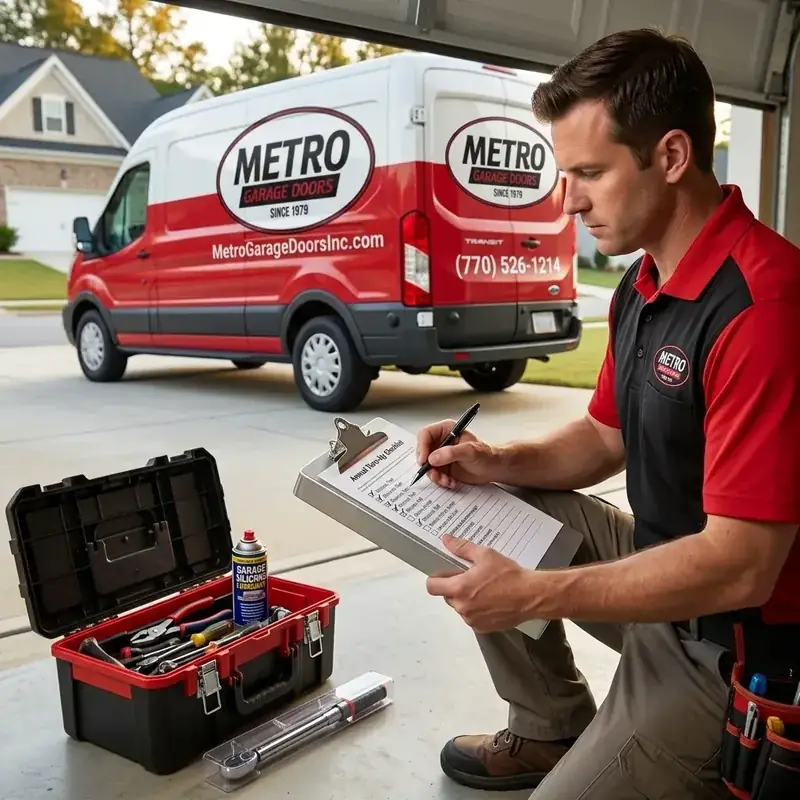
The fix is a socket wrench and fifteen minutes with the door closed and the opener unplugged. Snug every accessible track-bracket bolt, hinge bolt and opener-bracket fastener. Snug is the word: overtightening strips the small sheet-metal screws and crushes hinge knuckles. Do not touch anything attached to the spring system, the big bolts on the torsion bar brackets and the cable drums are under load and are not yours to adjust.
One more rattle source hides overhead: a chain-drive opener with slack in the chain slaps the rail on every start and stop. Most units have a simple tension adjuster on the trolley rail. A quarter turn is usually all it wants.
06Popping and snapping
A pop or snap at the same point in every cycle is a worn part announcing its location:
- Dry torsion spring coils bind against each other and release with a pop, often at the start of travel. A stripe of lubricant along the spring usually silences it.
- A worn hinge with play in the knuckle snaps as the sections pivot through the track curve. The hinge number is stamped on it, and swapping one is simple with the door closed.
- A flat-spotted roller clicks or thumps once per wheel rotation. Same cure as the grinding version: new rollers.
Place the sound by standing inside with the door running and following it to one hinge, one roller or the spring bar. Whichever part it is, the pattern is the useful part: localized noise means a localized fix, not a whole-door problem.
07One loud bang
A single, startling bang from the garage, often with nobody near it, is the sound of a torsion spring reaching the end of its cycle life and letting go all at once. People report it as a firecracker, a gunshot, or something heavy falling off a shelf.
The confirmation is visual: look at the spring on the steel bar above the door. A healthy spring is one continuous coil; a broken one shows a clean gap of about two inches. The door will also suddenly act heavy, lifting a few inches and stopping, or straining the opener into its safety shutoff.
What not to do: keep pressing the button, lift the door by hand expecting the usual weight, or pull the red release cord while the door is up. With the spring gone the door is unassisted dead weight, well over a hundred pounds on most homes. Spring work is the one garage door repair with a genuine injury record, so this is where the guide hands off to same-day spring replacement. If you are not sure whether the spring is broken or just loud, spring repair starts with an inspection of the whole counterbalance system.
08When the opener is the noisy one
Disconnect test: pull the red release cord with the door closed, lift the door by hand through a full travel, then run the opener by itself. If the door is quiet by hand and the racket only appears with the motor running, the opener owns the noise.
- Loud by design. Chain drives are the tractor engine of the category, and an AC chain unit from fifteen years ago was loud the day it was installed. A modern belt-drive with a DC motor is quieter by an order most people find hard to believe until they hear it. The drive-type rundown is in our opener buyer's guide, and replacement is a same-day job.
- Louder than it used to be. A healthy opener does not get progressively noisier. Growing grind, whine or clatter points at the drive gear, the motor bearings or the trolley, all of which opener repair can assess in minutes. An opener fighting an unbalanced door also roars with effort, which is really a spring problem wearing an opener costume, and part of why the disconnect test matters.
- Structure-borne rumble. Some noise never comes through the air: it travels from the opener bracket into the ceiling framing and shows up as rumble in the room above. Rubber isolation pads between the mounting bracket and the framing break that path, a small job with an outsized effect.
09The quiet-door stack
For households with a bedroom or office over the garage, we install all of it at once, in order of effect:
- Sealed nylon rollers in place of steel. The biggest single change to door noise.
- Belt-drive, DC-motor opener with soft start and stop, so the door accelerates gently instead of slamming into motion.
- Full lubrication of springs, hinges and bearings with a product that lasts months, not days.
- Every fastener snugged, chain or belt tension set, limits and force dialed in.
- Vibration isolation at the opener mount where a living space sits above.
A door with this stack running on a balanced spring system is quiet enough that the complaint flips: some owners ask us whether it is actually closing. The whole package rides on the door being mechanically healthy first, which is what the tune-up inspection establishes before we change anything.
10When to call instead
Lubricating, tightening accessible bolts and swapping a hinge are honest DIY. The line is the same one that runs through every page on this site: anything under tension belongs to a technician. Springs, lift cables, cable drums, the bottom brackets they anchor to, and any door that bangs, strains or sits crooked in its opening.
Metro has been quieting Atlanta's garage doors since 1979 from two locations, Douglasville and Alpharetta. Every tech is a W-2 Metro employee, never a subcontractor, every truck carries rollers, hinges, springs and openers, and every job is quoted in writing before work starts. If your door is still loud after this page, repair service is one call away, same-day across the metro.
FAQ
Why is my garage door so loud when opening?
Nine times out of ten it is some combination of dry hardware and worn rollers. Steel rollers running in steel track get louder every year as their bearings wear, hinges and springs squeal when the lubricant dries out, and the vibration from all of that works track bolts loose, which adds rattle on top. A lubrication pass plus a hardware tightening quiets most doors dramatically, and swapping steel rollers for nylon removes most of what remains. If the noise is a motor-pitched grind or hum rather than wheel noise, look at the opener instead.
What does a grinding noise from my garage door mean?
Grinding during travel usually means roller bearings have worn out or a roller has stopped spinning and is dragging through the track with a flat spot. Grinding from the opener itself, especially with white plastic shavings visible on the motor housing, means the main drive gear is stripping, a classic failure on older chain-drive units. The roller version is cheap to fix and worth doing promptly, because a dragging roller stresses the hinges and can bend track over time.
My garage made one loud bang. Is that dangerous?
Treat it as a broken torsion spring until proven otherwise. A spring letting go releases its stored energy in a fraction of a second, and the bang is loud enough that most people think something fell over. Look at the spring on the bar above the door for a clean two-inch gap in the coils. Do not keep running the opener and do not pull the emergency release while the door is up. The door is now dead weight, far heavier than the opener or you should be lifting, so this one is a technician call.
How do I quiet a noisy garage door?
In order of cost: lubricate the springs, hinges and roller bearings with a garage-door rated silicone or white lithium spray, snug every accessible track and hinge bolt, then replace steel rollers with sealed-bearing nylon ones. If the remaining noise is the opener, a belt-drive replacement is the single biggest upgrade, and anti-vibration isolation between the opener and the ceiling framing helps in rooms above. Most doors get 80 percent quieter with just the first two steps.
Why does my garage door still squeak after lubricating it?
Three usual reasons. The wrong product, because a general water-displacing spray is a cleaner rather than a long-term lubricant and the squeak returns in days. The wrong spots, because the noise often lives inside roller bearings and under the spring coils rather than in the obvious hinge joints. Or the hardware is past lubricating, which is typical for original steel rollers after a decade of cycles. If two careful passes have not fixed it, the squeaking part is telling you it wants replacing.
Can you make my garage door opener quieter?
Yes, two ways. If the opener is healthy but loud by design, a chain drive for example, we can replace it with a belt-drive unit, which is the quietest common drive type and the standard recommendation when a bedroom sits over the garage. If the opener has become louder than it used to be, that is usually a worn gear or failing motor, and we can quote the repair against a replacement so you can choose. Same-day appointments across metro Atlanta at (770) 526-1214.