Garage doors come in more standard sizes than most people expect, and the right one is decided by three numbers you can collect with a tape measure in five minutes. This guide lists every common residential size, then walks through the measurements our installers take before ordering a door, so you know what fits before anyone sells you anything.
01The quick answer
If you just need the headline numbers:
- Single-car doors: 8 or 9 feet wide, 7 feet tall. 9x7 is the modern default.
- Double-car doors: 16 feet wide, 7 feet tall. 16x7 covers most two-car garages in America.
- Heights: 7 feet standard, 8 feet on newer or custom builds.
- The rule that surprises people: the door matches the finished opening exactly. A 16x7 opening takes a 16x7 door, no undersizing, no gap allowance. The door seals against the framing from inside.
That answers the common case. The rest of this guide covers everything the common case leaves out: intermediate widths, taller doors, RV bays, framing numbers, and openings that missed standard by a few inches.
02Single-car door sizes
Single-car doors run 8, 9, or 10 feet wide, almost always at 7 feet tall:
- 8x7: the classic single. Common on homes built through the 1980s, detached garages, and tighter lots. It clears a sedan with attention and a mirror check.
- 9x7: today's standard single. That extra foot is the difference between threading a modern SUV and just driving in, which is why nearly all newer construction uses it.
- 10x7: the truck-friendly single, increasingly framed into new builds and workshop garages. If you tow anything or park a full-size pickup, this is the width that stops the mirror folding ritual.
Many two-car garages in older Atlanta neighborhoods, Marietta and Decatur especially, use two singles with a center pier instead of one wide door. That layout survives because it keeps working: two smaller doors, two smaller spring sets, and one bay still opens if the other door fails.
03Double-car door sizes
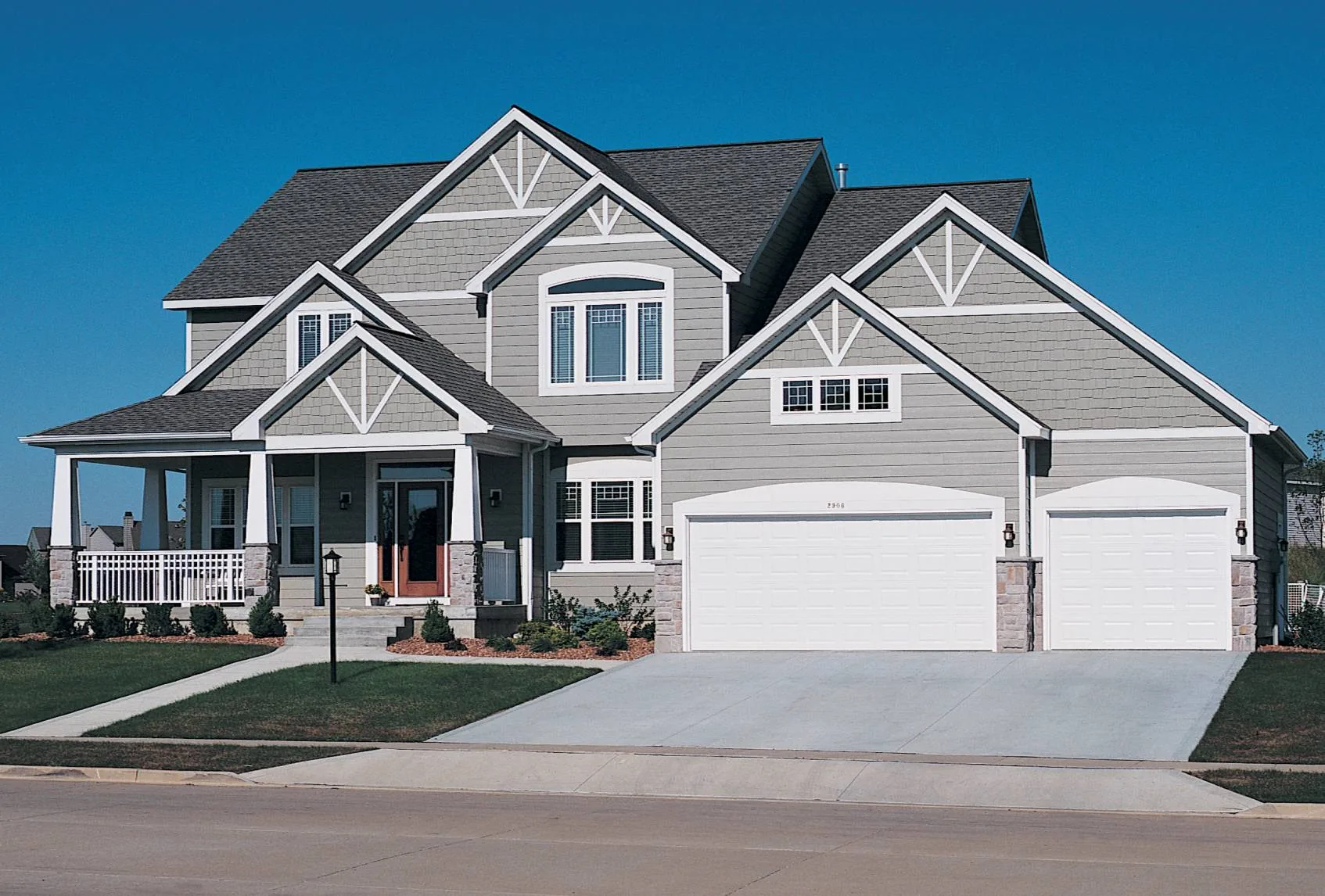
The standard double garage door size is 16 feet wide by 7 feet tall, and full double garage door dimensions run 12 to 18 feet wide:
- 12x7 and 14x7: the in-between widths. Not really doubles, they show up on oversized single bays, golf cart plus car garages, and older carports that were enclosed.
- 15x7: a tighter double, common on homes where the garage shares a wall line with living space and the framing came up short of 16.
- 16x7: the American standard double. Two vehicles side by side with workable clearance. If you buy a two-car home built after 1990, odds are this is your door.
- 18x7: the comfortable double, standard on newer builds with three-car aspirations and full-size trucks. The extra two feet mostly buys door-edge clearance, the thing you appreciate every single day.
One planning number worth having: two parked cars want about 6 feet of combined clearance across the opening, between them and to each jamb. A 16-foot door delivers it with midsize vehicles; two full-size trucks make the case for 18. If the framing is already set, the door matches the framing and the parking adjusts.
04Door heights: 7 ft, 8 ft, taller
7 feet is standard. It clears every passenger vehicle on sale, including full-size SUVs. 8 feet is the upgrade height, framed into many newer and higher-end builds, and it matters if you carry roof racks, a rooftop tent, or a lifted truck. Above 8 feet you are into RV and oversized territory, which residential manufacturers serve up to about 14 feet tall.
Height is the dimension your framing locks in. Width can sometimes be re-trimmed within an opening; raising a header is structural work. If you are choosing between a taller door and a wider one on a new build, our install crews will tell you the wider door gets used every day and the taller one gets used the day you buy the boat.
Taller and wider doors are also heavier doors, which changes the spring math and sometimes the opener. The numbers are in our garage door weight guide.
Height also decides the panel sizes. A sectional door is built from horizontal sections, usually 18, 21, or 24 inches tall, each as wide as the door itself. A 7-foot door is typically four 21-inch sections; an 8-foot door runs four 24-inch sections or five shorter ones, which is why an 8-foot door of the same style can look subtly different on the street. Replacement panels are matched to that section height and the door's model, not bought generically; if a single damaged section is the problem, that is a panel replacement rather than a sizing question.
05The full size chart
Every common residential size and where it belongs:
| Size (W x H) | Type | Typical use |
|---|---|---|
| 8x7 | Single | Older singles, detached garages, tight lots |
| 9x7 | Single | The modern standard single |
| 9x8 | Single, tall | Newer builds with 8 ft framing |
| 10x7 | Single, wide | Trucks, SUVs, workshop garages |
| 12x7 | Intermediate | Oversized single bays, enclosed carports |
| 14x7 | Intermediate | Car plus golf cart or mower bays |
| 15x7 | Double | Tighter two-car framing |
| 16x7 | Double | The standard American two-car door |
| 16x8 | Double, tall | Two-car with 8 ft framing |
| 18x7 / 18x8 | Double, wide | Newer builds, full-size trucks |
| 5x7 / 6x7 | Specialty | Golf cart doors |
| 10x12 to 14x14 | Oversized | RV and boat bays |
Every size in this chart is available across the styles we install, from basic steel to carriage-house and full-view glass. Style changes the look and the weight; it does not change the sizing rules.
06The five measurements that matter
Before any door is ordered, five numbers get taken. Grab a tape measure and a step ladder and you can collect all of them in five minutes:
- Opening width. Inside edge to inside edge of the finished opening, measured at the widest point. This is your door width.
- Opening height. Floor to the underside of the header. Measure at both sides and the middle; garage floors are rarely level, and the door gets sized to the opening, with the bottom seal handling minor floor variation.
- Sideroom. The flat wall space beside the opening on each side. The vertical track needs roughly 3.75 inches per side. Less than that and the track hardware needs a workaround, which is an installer conversation, not a dealbreaker.
- Headroom. From the top of the opening to the ceiling or the lowest obstruction, ducts, pipes, and garage door openers included. Standard track with a torsion spring wants 10 to 12 inches. Tight garages can drop to roughly half that with low-headroom track, another installer conversation.
- Backroom. From the opening into the garage. The horizontal track and a raised door need the door height plus about 18 inches, and an opener wants a little more.
What each part of that hardware actually does, track, springs, drums, and the rest, is mapped out in our garage door anatomy guide.
07Rough opening and framing
If you are building or reframing, the framing rule is simpler than most guides make it sound: frame the finished opening to the door size. A 16x7 door gets a 16-foot-wide, 7-foot-tall finished opening. The door is installed behind the opening and closes against the jambs, sealing the full perimeter, so there is no undersizing offset like a window or entry door.
Around that opening, plan for:
- A structural header sized for the span, which for a 16 or 18 foot opening is serious lumber or steel and belongs to your framer or engineer.
- Solid jamb and header framing, because the track brackets and the spring system anchor into it. The spring assembly loads its anchor point every cycle; soft or split framing there is the root of rattles and worse.
- The clearances from section six: 3.75 inches of sideroom, 10 to 12 inches of headroom, door height plus 18 inches of backroom.
Metro installs into new framing constantly across metro Atlanta. If your framer wants the exact rough-in sheet for a specific door, send us the plans and we will confirm the numbers before the header goes up.
08RV, golf cart, and oversized doors
Two ends of the specialty spectrum:
- Golf cart doors run 5 or 6 feet wide by 7 feet tall. Common in golf communities around Peachtree City and on properties with a shed bay. They use the same hardware as full doors, scaled down.
- RV doors start where residential stops: 10 to 14 feet wide and 12 to 14 feet tall. A Class A motorhome with roof gear generally needs 14 feet of clear height, which means the building is designed around the door rather than the other way round. These run heavier gauge track and commercial-grade springs.
Past roughly 18 feet wide or 14 feet tall you are into commercial sectional territory, which we also install; that world is covered on our commercial doors page.
09Custom garage door sizes
Openings miss standard constantly: a 1950s garage framed at 8 feet 4 inches, an enclosed carport at 15 feet 6, a renovation that traded headroom for a beam. Custom garage door sizes exist for exactly these cases, and the manufacturers we install build them to order:
| Situation | Custom answer | What to expect |
|---|---|---|
| Opening inches off standard (8 ft 4 in, 15 ft 6 in) | Door built to the measured width, usually in 2- or 3-inch increments | The everyday custom order. Lead time over cost; often the same series as the stock door. |
| Non-standard height (6 ft 6 in, 7 ft 6 in) | Custom section heights to hit the opening | Common on older intown garages and basement bays with low headers. |
| Very wide single opening (11 to 13 ft) | Custom-width door with reinforcing struts | Wind load and sag control drive the build more than the width itself. |
| Arched or angled opening | Standard rectangular door behind custom trim | The door stays square; carpentry shapes the reveal. Cheaper and more reliable than shaped doors. |
| Opening close to a stock size | Reframe or re-trim to standard | Worth it mainly when the framing needs work anyway. |
Two honest paths, in practice:
- Order the door custom. The manufacturers we install, including CHI and Amarr, build to order in small increments of width and height. Custom sizing costs lead time more than money, and it is almost always cheaper than moving framing.
- Reframe to standard. Worth it mainly when the framing needs work anyway, or when the opening is close enough to a standard size that trimming the jambs gets you there.
The wrong path is forcing a stock door into an opening it does not fit. An undersized door leaks light, air, and pests around its perimeter; an opening trimmed too casually compromises the framing the whole system hangs from. Measure, then order to the measurement.
10Replacing an existing door
Replacement is the easy case: the opening already told you the size. Measure the finished opening, width and height, and that is the door you order. Two wrinkles worth knowing:
- Measure the opening, not the old door. Old doors are occasionally the wrong size for their own opening, installed with overlap or shimmed jambs to make a stock size work. The opening is the truth.
- Weight changes ripple. Swapping a thin steel door for an insulated or wooden one changes the door's weight, which means new springs matched to the new door, and occasionally an opener conversation. Our weight guide has the numbers, and every Metro door install includes springs sized to the door being hung, not the one coming down.
Metro has been measuring, ordering and hanging Atlanta's garage doors since 1979 from two locations, Douglasville and Alpharetta. Every quote is written, every install is a W-2 Metro crew, and the showroom floor in Douglasville has the styles hanging full-size if you want to stand under them before deciding.
FAQ
What size is a standard 2-car garage door?
16 feet wide by 7 feet tall is the standard American double-car door, and it is what the large majority of two-car garages in metro Atlanta carry. 15 by 7 shows up on slightly tighter builds, 18 by 7 on wider ones, and 16 by 8 where the builder framed for extra height. If you are replacing an existing double door, measure the opening rather than assuming: a tape across the finished opening settles it in ten seconds.
What size is a standard single-car garage door?
8 feet wide by 7 feet tall or 9 by 7. Older and tighter garages lean 8 wide, newer builds lean 9 because modern vehicles are wider, and 10 by 7 appears on newer construction that anticipates trucks and SUVs. Height is 7 feet in nearly every case unless the builder framed for 8.
What is the rough opening for a 16x7 garage door?
The finished opening should match the door: 16 feet wide by 7 feet tall. The door closes against the framing rather than inside it, so you do not oversize the opening the way you would for a window. Beyond the opening itself you need roughly 3.75 inches of flat sideroom on each side for the vertical track, about 10 to 12 inches of headroom above the opening for standard track and the torsion assembly, and backroom into the garage of the door height plus about 18 inches.
Can I fit a taller door in my existing opening?
Not without reframing. An 8-foot door needs an 8-foot finished opening plus the headroom above it, so going taller means raising the header, which is structural work. The practical questions are whether the garage has the ceiling height to spare and whether the payoff justifies the framing. Our techs can tell you both in one visit, and where the header stays put, a wider door is often the easier win than a taller one.
Do garage doors come in custom sizes?
Yes. The manufacturers we install, including CHI and Amarr, build to order in small width and height increments, so an opening of 15 feet 6 inches or 9 feet 4 inches does not force a rebuild of your framing. Custom sizing adds lead time rather than drama: we measure the opening, order the door built to it, and install when it arrives.
Does a bigger garage door cost more?
Size is one input alongside material, insulation, windows and springs, which is why we quote rather than publish a chart. Every Metro new-door quote starts with a free in-home measure, the price is written and itemized before anything is ordered, and the number on the estimate is the number on the invoice. Book a measure at (770) 526-1214.